From Root to Sculpture at Medford Craft World
By Jayne Bostock
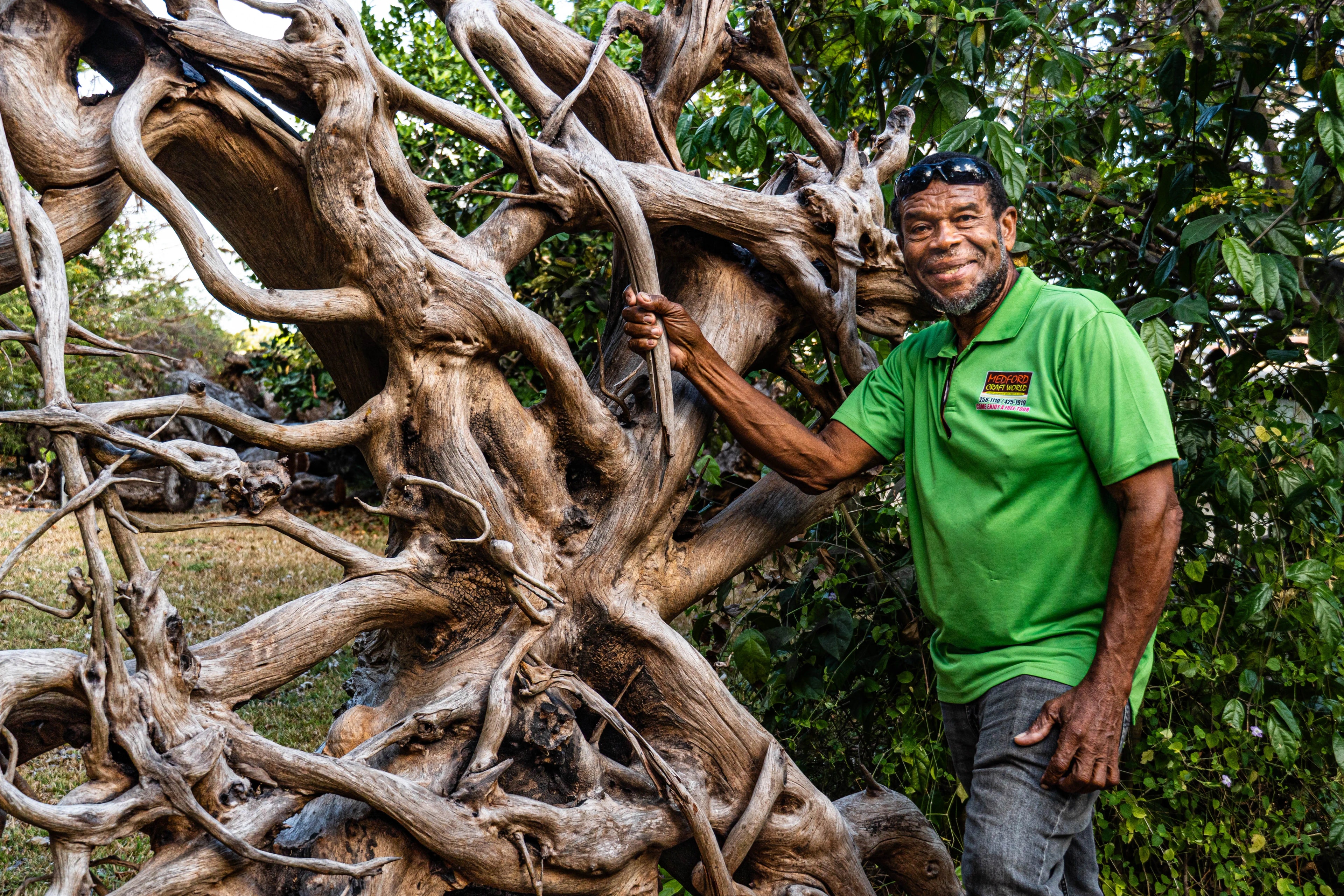
Near the entrance, a mahogany root stands in its natural form: a circular tangle of limbs, almost human arms reaching out from the core, bark intact, cleaned but not carved. Right beside it stands something that barely reads as a root at all: a towering mass of soil and rocks, decades of compacted debris packed into the grain, the wood buried somewhere deep within; nothing about it looks remotely like art. Reggie Medford has spent fifty years turning mahogany roots like this into sculpture. He keeps coming back to it over months, even years, breaking away the compacted earth with a pickaxe, clearing mud, nails, bottles and, he says with a straight face, possibly some dinosaur bones, until it slowly starts to reveal itself. "It's like a puzzle," he says. "And then one day, as I'm looking, it appears in front of me."
A visit to Medford Craft World traces that journey. Every part of the acre-and-a-half property is in use: thick trunks, root masses, and branches lie across the grounds in every stage of transformation, each one at a different point in Reggie's long process of observation; some he has been studying for years, waiting to see what they want to become. Behind the workshop stands a mahogany tree Reggie will never use. It was half its current size when he arrived here twenty-five years ago, struggling; he brought in truckloads of soil to restore the land around it, and it has been thriving ever since. It stands as proof of what patience and careful attention can produce.
Reggie's instinct for using what others would throw away goes back to 1975, when he left school at nineteen with A-levels in biology and geography and one fixed idea: he was not going to work for anyone else. His parents' garden had fifty coconut trees, their shells lying on the ground, of no use to anyone. Nobody had thought to do anything with them. Reggie picked one up. Armed only with a hacksaw, sandpaper, and varnish, he cut the shells into earrings and bracelets and started selling them; within a couple of years he had shelf space at Best of Barbados and in shops on Bridgetown's Broad Street, a rare achievement for a locally made craft product at the time. By the early 1980s, he was ready for a new challenge. "There are only so many things you can do with a coconut," he says.
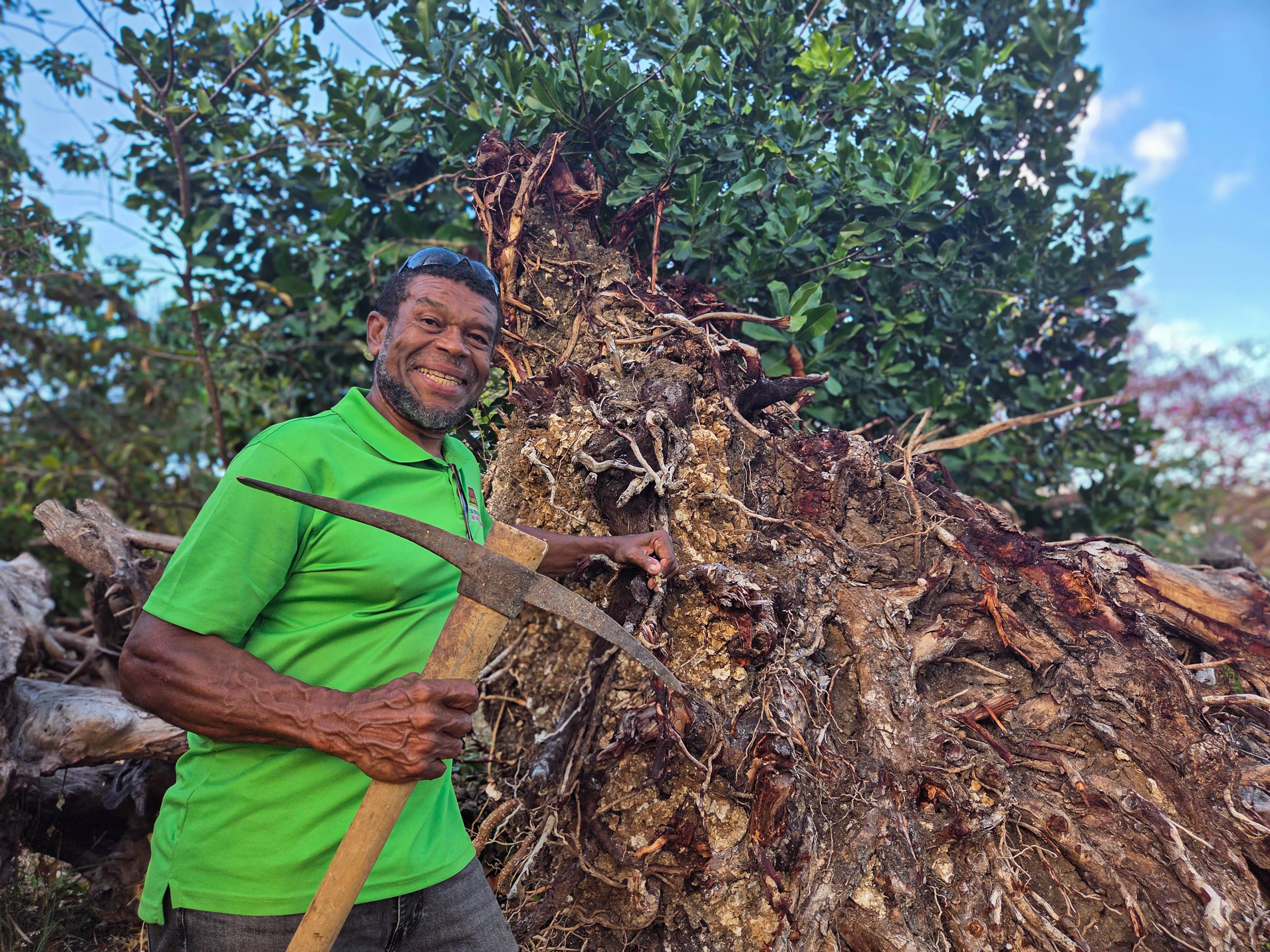
The shift to mahogany began when Reggie watched a row of trees being cleared from a site and saw the root system headed for landfill. "To me, it was a travesty," he says. He asked if he could take the roots, brought a piece back to the workshop, and carved a fish; three-dimensional in a way the flat coconut shell had never allowed. "I was on cloud nine. So many things spawned in my head." The same logic that had led him to the coconuts pulled him here: free material, destined for disposal, full of untapped possibility.
Every tree Medford Craft World uses today is sourced under government permit, collected from cleared land and fallen trees across the island. The whole tree arrives, branches, trunk, and roots together, and nothing leaves unused; some of the wood on the property has been sitting there for twenty years and is still good. Barbados has had mahogany craftsmen for centuries, Reggie says; they have always worked the timber. What he does differently is the roots: the parts that have always gone straight to landfill, that nobody else wanted. "What a waste," he says, of the ones that don't make it to him.
Reggie's studio sits inside a rambling old wooden building at the end of a path lined with mango and ackee trees. The air smells faintly of varnish and mahogany dust, and the floors and beams carry the marks of decades of work. During our visit, green monkeys drawn by the fruit made it as far as the studio stairs, arriving halfway through the tour. The workshop runs across the bottom two levels, and much of the process it contains is Reggie's own invention. "I don't know what a chisel looks like," he says, after fifty years at it. Everything here is done with sanding machines; a technique he and his team developed from scratch because nobody had worked with root wood this way before. When a curve demands it, a nail with its head cut off and wrapped in sandpaper reaches into the deepest hollow. On the second level, Ricky is dip-varnishing today, lowering finished pieces into varnish rather than brushing; the only way to coat every surface of a three-dimensional root sculpture evenly. He and Grantley have been here for over fifty and forty years respectively, master craftsmen in their own right, each with techniques that are entirely their own.
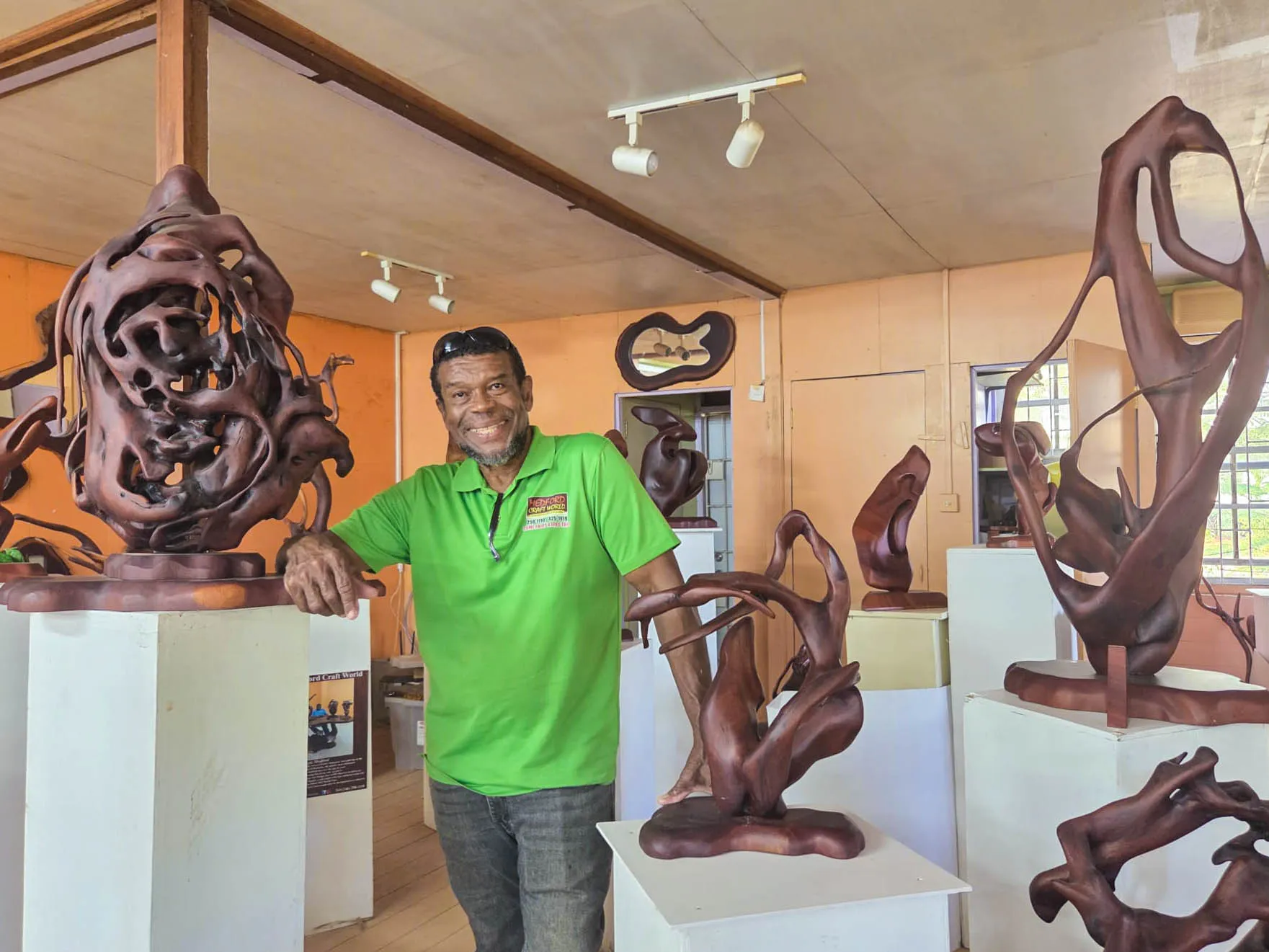
Root sculptures fill the top level showroom, sitting alongside mirrors, clocks, miniature sailing boats, carved green monkeys, vases, and pieces shaped like the outline of the island itself; all handmade, all mahogany, none of it made from wood that wasn't already on its way out. Reggie moves easily between visitors, asking where they're from, stopping to explain a particular grain pattern, answering questions with warmth and the occasional mischievous aside delivered so deadpan it takes a second to register. Reggie encourages them to look at a sculpture from different angles, and what happens next is genuinely hard to predict: one person sees a map of the universe, another sees something alien, a third sees something closer to a womb. Different people see different things in the same piece, and that, more than the craft, seems to be what Reggie is most pleased about. "I feel a real sense of joy in having created this," he says. "The transformation is so profound that even after all these years, you just can't believe this is where it started."
Helpful Hint: Allow an hour for a visit. If you are driving, the entrance is easy to miss from the road; follow the signs rather than GPS, which reliably sends visitors the wrong way. If you are interested in having a commissioned piece, reach out to Reggie at least a week in advance of your visit if possible.