Barbados Exchange Museum
By Rekke Editorial
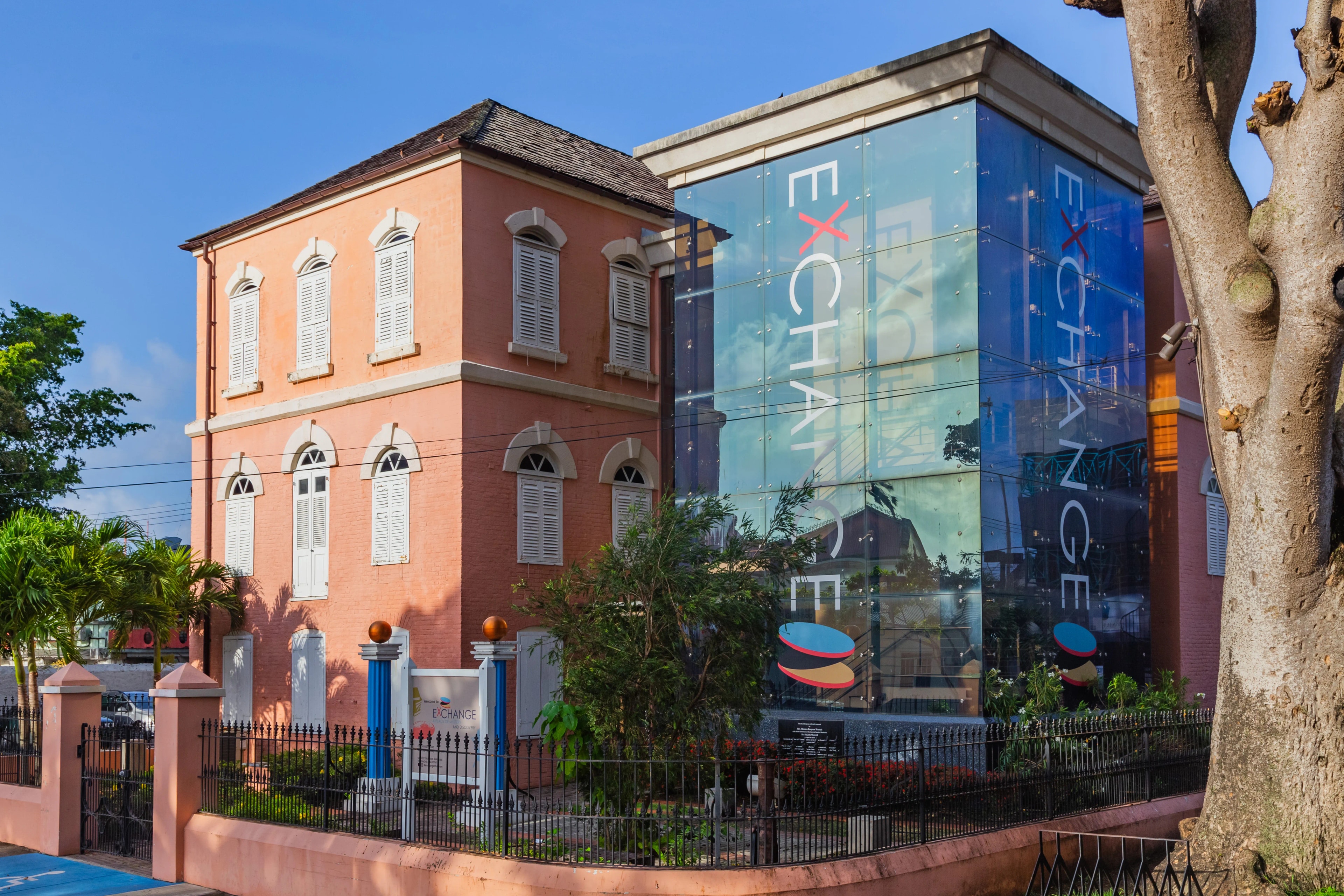
From Spry Street, the Exchange Museum sits quietly between old Bridgetown and the glass-and-steel extension of the Central Bank next door. The two blue columns at the entrance, Boaz and Jachin, the pillars of Solomon’s Temple, found at the door of every Masonic lodge in the world, are the first clue that this museum might be about more than just money.
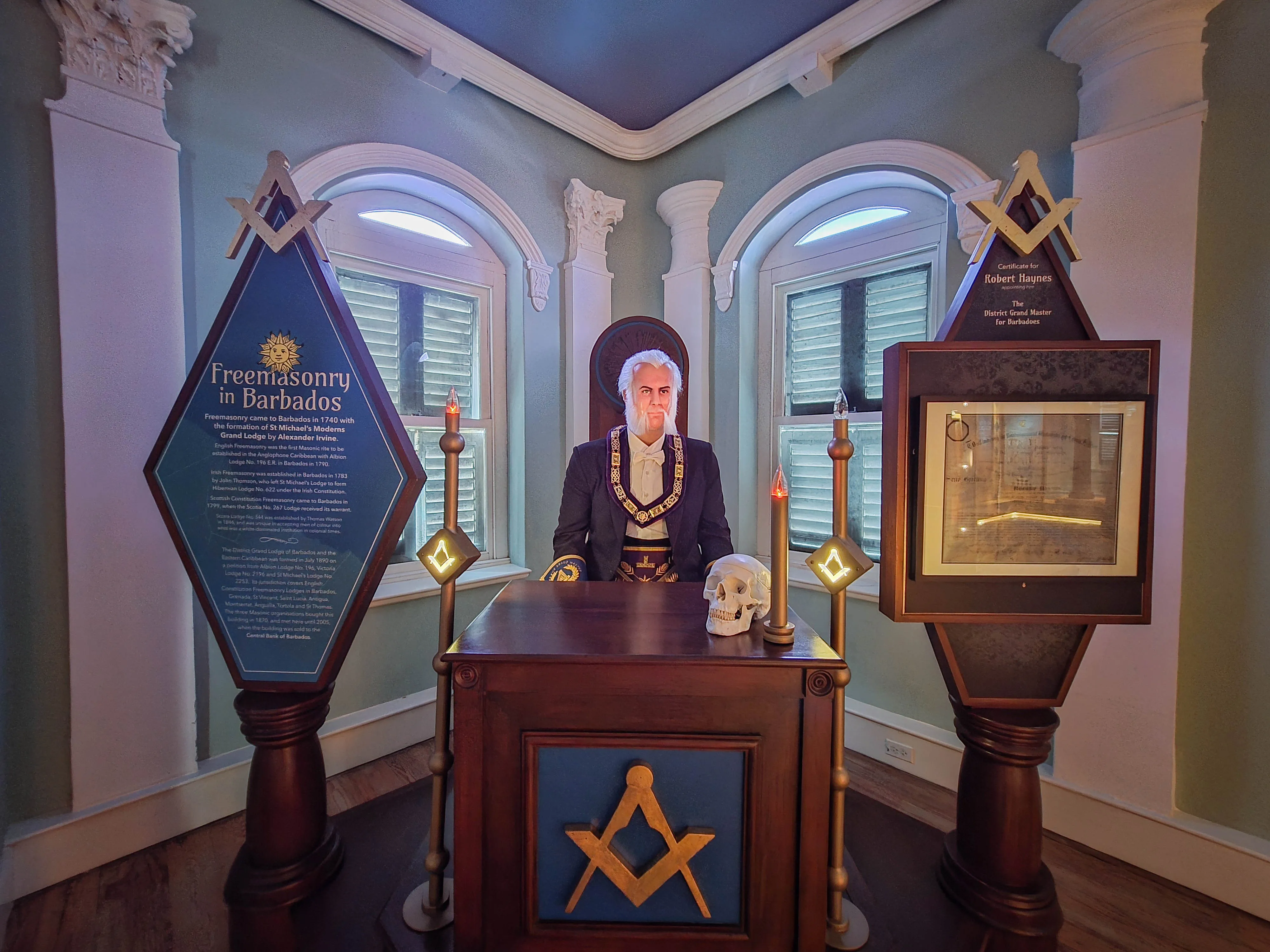
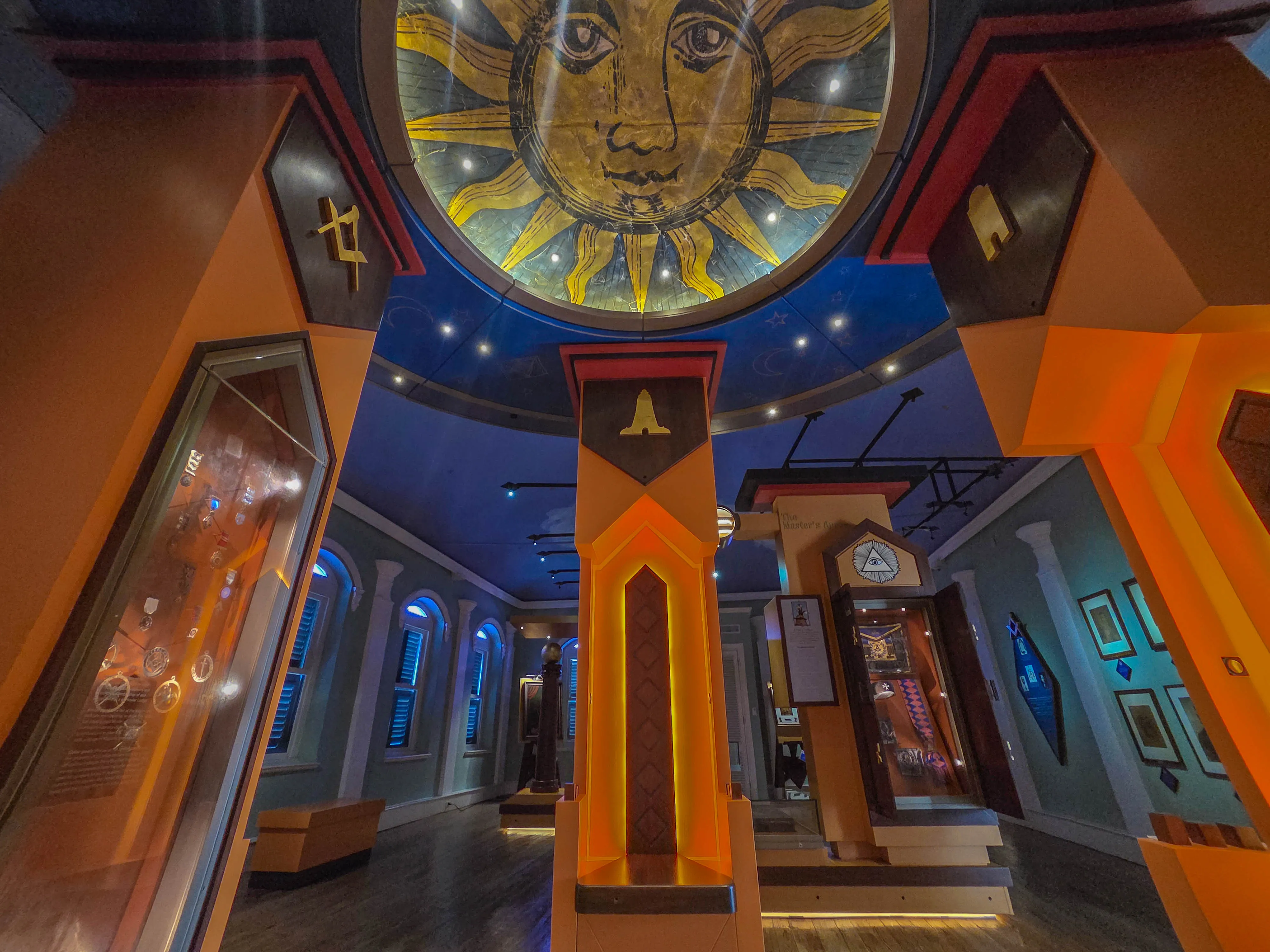
The Masonic room is not what anyone expects inside a museum in Barbados — or anywhere, really. The ceiling is a deep navy blue with a great golden sun painted at its center: a face, rays spreading outward, moon and stars and a comet arranged around it. The Masons called it the canopy of heaven. The floor below is laid in black and white chequer, representing, a panel explains, the good and evil of human life. Orange-lit pillars bear the compass and square. Figures in Masonic robes stand still at the edges. And at the far end, in a small room of its own, a wax figure of the District Grand Master sits at his desk between two flickering candles, a skull placed in front of him.
Brian Batson, who has guided tours here since the museum opened in 2016, picks it up without ceremony. “No one escapes death,” he says — mason or otherwise. The skull is not, he explains, meant to disturb. In the Masonic tradition, it is motivational.
Three Lives
The building on Spry Street has held three different institutions in nearly 280 years. In 1745 it opened as Harrison’s Free School, a charity school for up to 24 boys, funded by the estate of merchant Thomas Harrison, who’d purchased the land in 1733. A hurricane damaged it in 1780 and it was repaired. It kept its doors open until 1871, when the school moved to Roebuck Street, where Harrison College stands today, and the Freemasons purchased the property, adding a third storey for their Lodge. In 2005 the Central Bank of Barbados acquired it. After an extensive restoration, the museum opened in 2016. The stone walls, shuttered windows, and carved entrance columns are original; the modern glass-and-steel extension you pass on the way in is the only visible addition.
Commerce and Currency
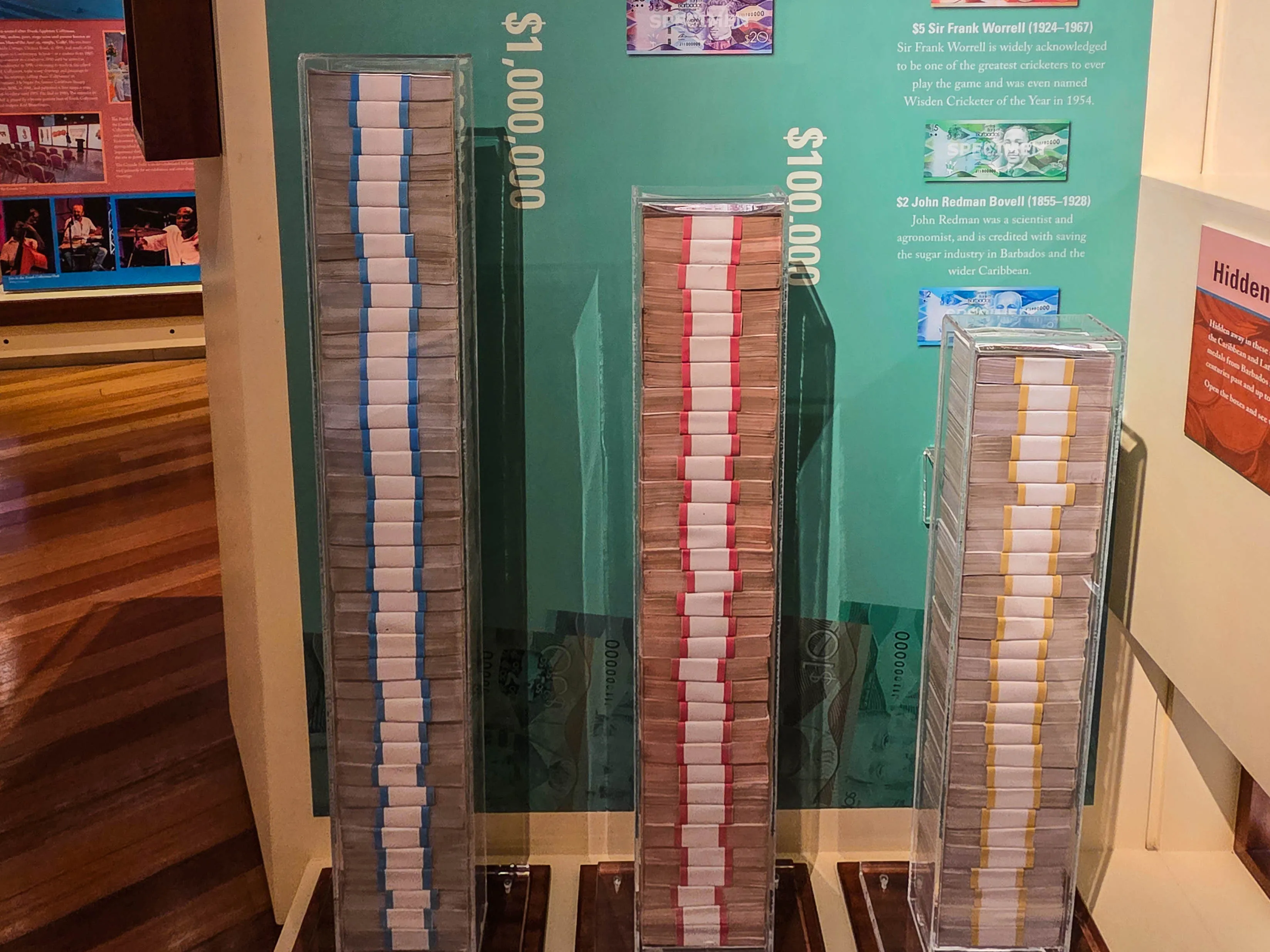
The floor below covers the story of the port in Bridgetown. From 1628 onward, its harbour was one of the most active in the Atlantic world, and you feel the weight of that in the maps and trade ledgers, and in the display of pieces of eight — the silver Spanish coins that funded Caribbean commerce and, as the museum notes without fanfare, later appeared as props in Pirates of the Caribbean.
The figures who shaped Bridgetown’s economy are presented in full complexity. Rachel Pringle, a free woman of color born to an enslaved mother, owned the Royal Navy Hotel in the 1780s and ran it with enough confidence to hand the future King William IV an itemized bill for everything his crew destroyed during a visit. She was a popular enough figure that sailors carved her likeness onto whale’s teeth. The museum doesn’t conceal that she also enslaved others — hotel-keeping establishments like hers, which often advertised as selling pickles, were likely trading in other things too. London Bourne, born into slavery and later one of Bridgetown’s wealthiest merchants, is also commemorated here; London Bond Towers on Bay Street carries his name today.
Near the ground floor there’s a working coin press — a hand-cranked machine in a glass case, its gears visible through the sides, a handle that protrudes for visitors to use. For one Barbadian dollar, you turn it yourself and the machine stamps a coin. You choose the design: the Exchange Museum, the Masonic Lodge, or the school — one for each chapter of the building’s history. Children love it. Adults, asked to turn a handle, reliably do too. Ask at the desk if you need a dollar coin for the press.
The Lodge
Freemasonry came to Barbados in 1740 when Alexander Irvine founded St Michael’s Moderns Grand Lodge. The second floor explains what it all means: the white apron edged in light blue, the candidate who arrives blindfolded with one trouser leg rolled up and one shoe missing, the Tyler at the door, armed with an unsheathed sword, who admits only those who give the correct sequence of knocks.
The Lodge did not always match its stated ideals. Overton, a Black Barbadian mason accepted by the Grand Lodge of England, was refused entry to local lodges after white members petitioned against him.
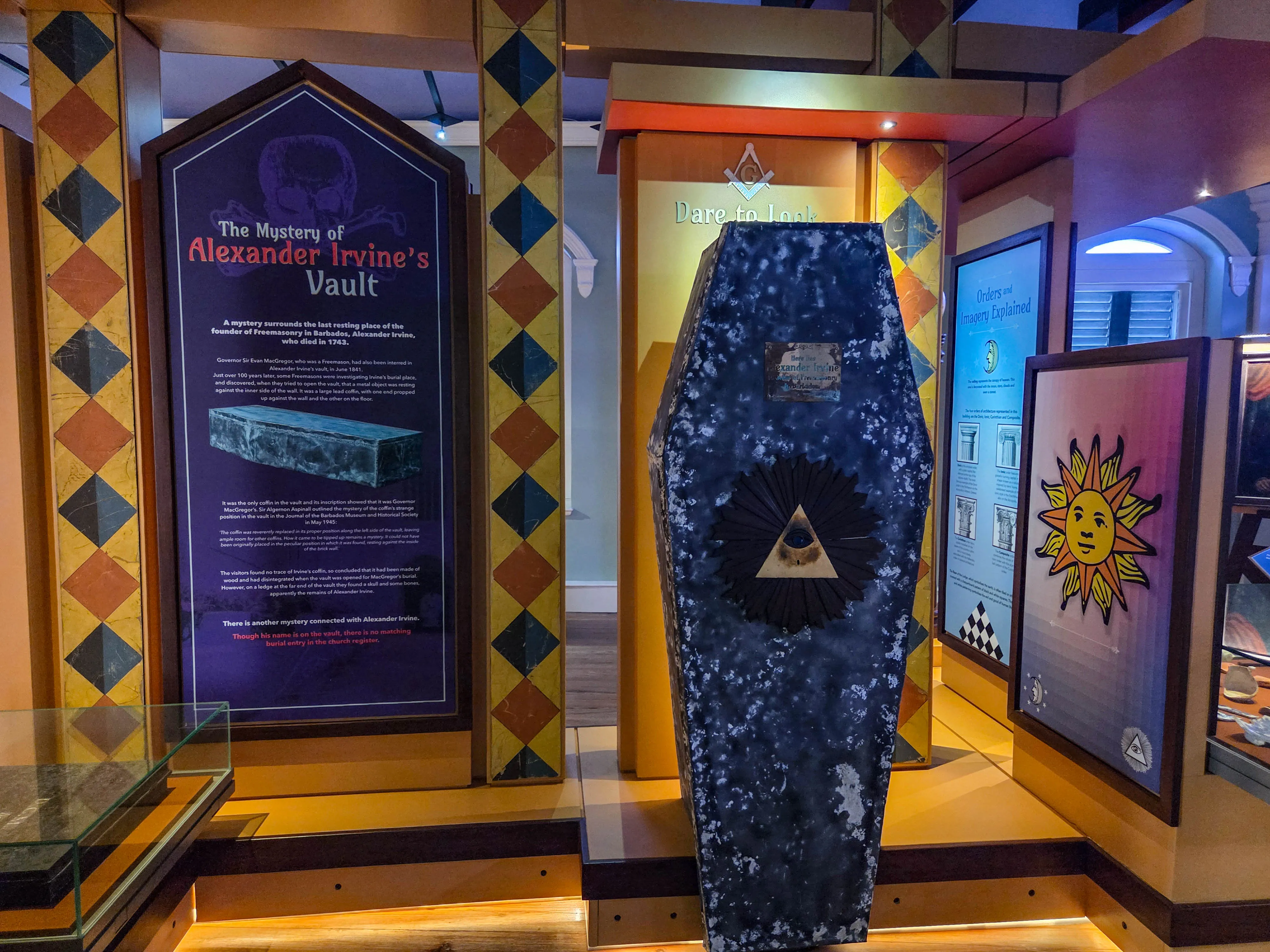
Alexander Irvine died in 1743. More than a century later, Freemasons investigating his vault found it disturbed: the coffin of a later interment tipped against the wall at an angle it could never have been placed in originally. Of Irvine’s own wooden coffin, almost nothing remained — only a skull and some bones on a ledge at the back. No explanation has ever been offered. Though his name is on the vault, there is no matching burial entry in any church register. Above the replica vault, in gold letters: Dare to Look.
Good to Know
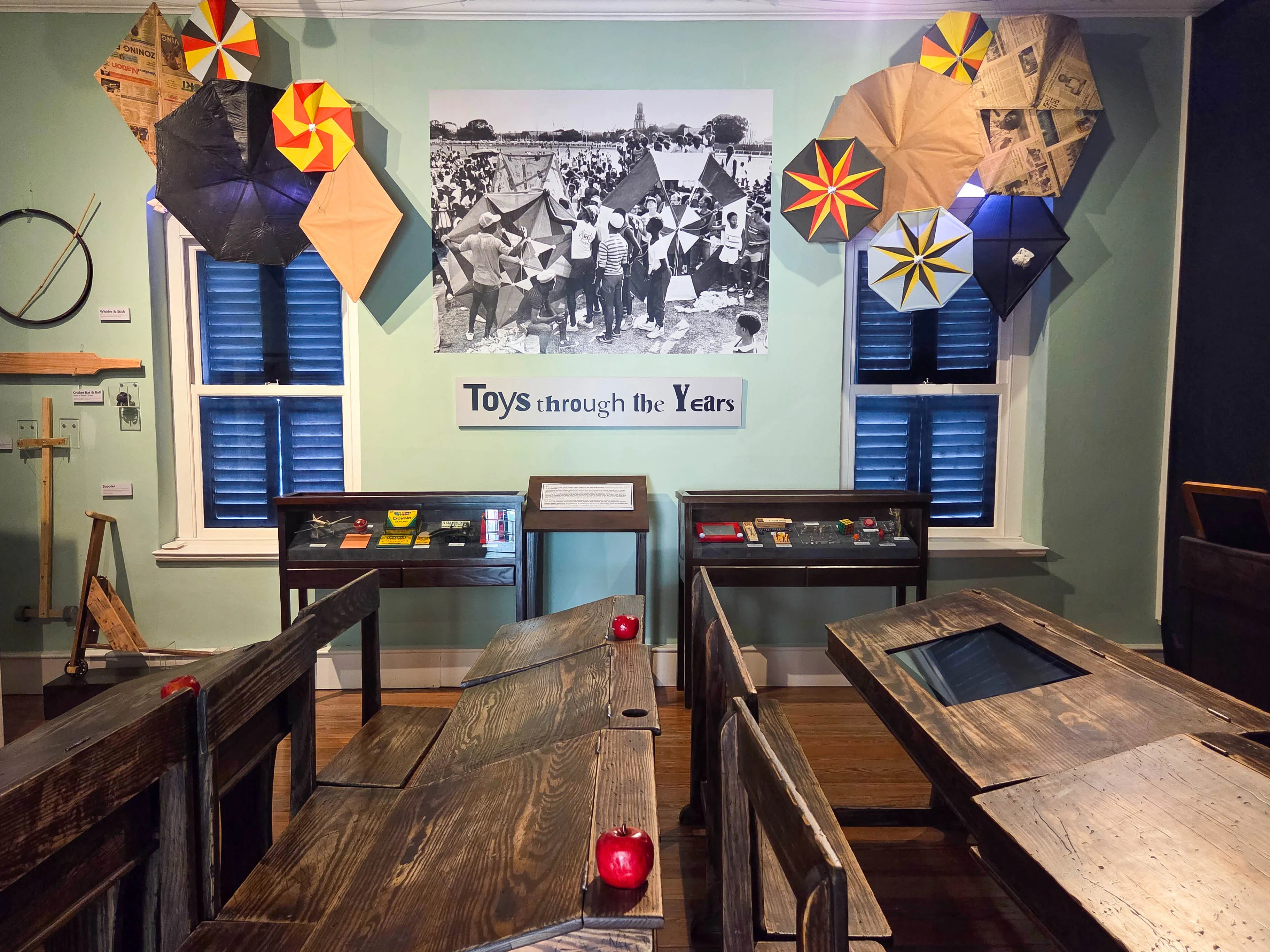
Interactive features run through every floor, making this a museum that rewards the curious at any age. The recreation of a Victorian schoolroom, with period wooden desks and colorful kites on the wall, is particularly good for children.
The lifelike wax figures throughout — the Grand Master, Rachel Pringle, the cricketers, and others — were created by Frances and Art at the nearby Caribbean Wax Museum.
Open Monday to Friday; tours are guided and included with admission, but there is also the opportunity to explore at your own leisure. Allow at least an hour for a visit.
Helpful Hint
Can't find the Exchange Museum? Ask anyone for the Lodge — locals have known it by that name for generations, and you'll be pointed in the right direction immediately.
There is a car park directly outside, though Bridgetown's streets aren't always easy to navigate; arriving on foot from Broad Street is often simpler.